Choose timezone
Your profile timezone:
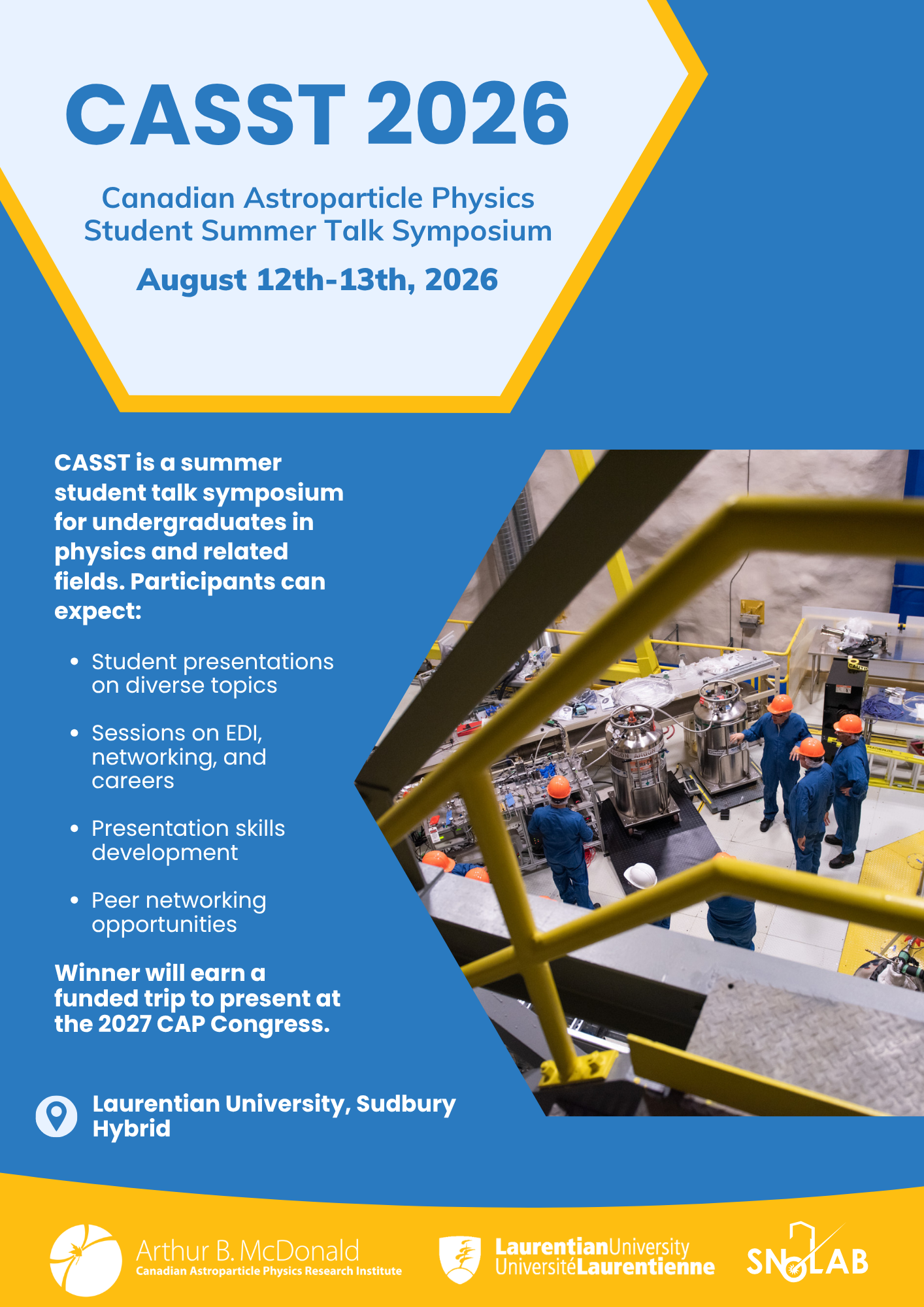
.png) The Canadian Astroparticle physics Summer Student Talk (CASST) symposium is for undergraduate students to show their work and will include networking opportunities and professional development sessions. Participation in person or virtually is welcome. Prizes will be awarded for best talks.
The Canadian Astroparticle physics Summer Student Talk (CASST) symposium is for undergraduate students to show their work and will include networking opportunities and professional development sessions. Participation in person or virtually is welcome. Prizes will be awarded for best talks.
All summer students who are not currently engaged in graduate studies or have a graduate degree are encouraged to attend and submit an abstract. A final programme will be posted following registrations. Talks will be 10 - 12 minutes in length plus a few minutes for questions. Final talk length to be determined based on number of abstract submissions
The competition is co-sponsored by SNOLAB and the McDonald Institute.
Pulsars provide a sensitive probe of heliospheric plasma through propagation-induced variations in dispersion measure (DM) (which measures the total electron column density) and scattering (which measures the scale of density perturbations perpendicular to the line of sight), particularly during solar conjunction. The Canadian Hydrogen Intensity Mapping Experiment (CHIME), together with its outrigger stations across North America, enables high-cadence, multi-baseline radio observations that are well suited for investigating these propagation effects.
We analyze CHIME observations of the Crab Pulsar (PSR B0531+21) obtained during solar conjunction. Multi-station correlation analyses are used to characterize scattering signatures while the high sensitivity of the main station provides DM measurements. Preliminary results show enhanced dispersion measure and scattering during close solar approaches, consistent with increased plasma density and turbulence along the line of sight.
We compare the measured DM variations with DM predictions derived from both an idealized Parker solar-wind density model and Parker Solar Probe (PSP) SWEAP observations. Electron density profiles are estimated from PSP measurements within time windows centered on each pulsar observation and mapped into the Earth–Crab Line of Sight (LOS) geometry to predict the corresponding solar-wind DM contribution. To better isolate the heliospheric component, we model the slowly varying interstellar DM contribution as a time-dependent trend rather than assuming a constant background.
Together, these analyses demonstrate the potential of combining multi-station pulsar observations, theoretical solar-wind models, and in-situ spacecraft measurements to quantitatively investigate the density structure and turbulence of the inner heliosphere.
The NEWS-G experiment is a dark matter search that uses spherical proportional counters to detect low-energy particle interactions with great sensitivity. My work entails developing and implementing a new sensor design for the detector and perform experimental characterization through stability and spatial gain uniformity measurements using an Fe-55 source. These measurements are being used to evaluate detector performance and optimize the sensor operating conditions.
This talk goes over some of the major infrastructure “anomalies” I dealt with at SNOLAB, mainly the VM host migration, cluster issues, and the cybersecurity work that came out of it. Goal was to secure the systems, contain whatever broke, and protect the research services people actually rely on. Armed with admin access, incomplete documentation, and a lot of troubleshooting.
Robust slow-control infrastructure is required to host meaningful noble liquid detector R&D, particularly on sophisticated light detectors at cryogenic temperatures. My work focuses on building an integrated slow control system for real-time data monitoring, automated and remote slow control, and a data analysis chain for a liquid argon cryostat. This talk will cover the slow control system design, testing, and uses for characterizing SiPMs for DarkSide-20k and hosting future liquid argon detectors.
Dark galaxies are structures characterized by a large dark matter halo devoid of star formation. Although they are both predicted by the Lambda Cold Dark Matter model and present in cosmological simulations, definitive observations of dark galaxies do not yet exist. In this work, we search for potential dark galaxy candidates in HI detections made by the Arecibo radio telescope from 2005 to 2012. We do so by cross-referencing multiple catalogs of Arecibo Legacy Fast ALFA (ALFALFA) observations believed to lack an optical counterpart in visual surveys. These catalogs include those compiled by Kwon et al. 2025 and Luke Leisman in his 2017 senior thesis. By analyzing their spectra and associated imaging counterparts, we develop a list of 73 detections that are best fit for follow-up by the Green Bank Telescope (GBT), which will reproduce their spectra at a much higher sensitivity than previously done.
A single-phase liquid argon chamber is in development by the SCALAR group at Queen's University as part of a research and development program for future liquid argon dark matter detectors. A Geant4 simulation is being developed alongside the detector to model its response, guide design, and evaluate performance. This talk will focus on my contributions to the simulation through the implementation of major radioactive backgrounds and alpha calibrations, and how these developments complement ongoing hardware efforts.
Radon (222Rn) is a prominent background source in the low-background SNOLAB experiments. Silver doped zinc sulfide (ZnS:Ag) is used as a scintillator in a radon counter known as a Lucas Cell. Commercial ZnS:Ag is readily available, but it lacks the purity required for low-background applications. This project focuses on synthesizing ZnS using selective precipitation to remove trace impurities, then doping it with silver and testing it against the commercially made product.
The High Energy Light Isotope eXperiment (HELIX) is a multi-phase balloon-borne experiment that aims to measure the isotopic abundance of cosmic-rays with energies between approximately 0.2-10 GeV/n. The time-of-flight (TOF) system, one of HELIX’s subdetectors, was used to measure the charge and velocity of nuclei passing through with energies of up to 1 GeV/n. The top and bottom of the TOF are each made up of eight scintillating paddles with eight silicon photomultipliers (SiPM) at each end. Data from groups of four SiPMs are read by front end electronics (FEE) which provide information on the charge and timing of the cosmic rays passing through. This presentation will focus on the charge calibrations performed on the data with a goal of uniformly detecting each cosmic ray passing through the TOF system to obtain accurate charge measurements throughout the detector.
This thesis investigates whether an external gravitational wave (GW) can meaningfully alter the inspiral of an existing compact binary. Using linearized general relativity, geodesic deviation, and a driven-oscillator model applied to systems including PSR B1913+16 and OJ 287, I find that realistic external waves are far too weak to have a significant effect, although an extreme hypothetical “GW laser” could in principle slow, halt, or reverse an inspiral.
The RAdioactive isotope Measurement Program at SNOLAB (RAMPS) is a deep-underground nuclear-physics experiment designed to perform precision measurements of rare decays in long-lived isotopes. This is of particular interest to geochronology, astrophysics, and nuclear physics. Its pilot experiment aims to search for the previously unobserved electron-capture (EC) decay of $^{176}$Lu to the first excited state of $^{176}$Yb, which is a fifth-forbidden transition. Current experimental lower limits indicate a half-life of $10^{13}$ to $10^{14}$ years, while theoretical limits suggest a half-life of greater than $10^{19}$ years. The experiment uses LYSO, a lutetium-containing scintillator, as both the radioactive source and an active detector. Scintillation light produced by the low-energy atomic relaxation following electron capture is measured using a Silicon Photomultiplier (SiPM), while a High-Purity Germanium (HPGe) detector searches for the characteristic 82.13-keV de-excitation gamma ray. Requiring coincidence between the two detectors is expected to strongly suppress backgrounds from the dominant beta-decay branches. Additionally, operation within SNOLAB’s deep-underground, low-background environment will substantially reduce the background relative to previous above-ground measurements. This will potentially enable the first observation of the EC decay or establish a more stringent lower limit on its half-life. RAMPS will also provide a detector infrastructure for future precision measurements of other long-lived isotopes.
This report details a project management placement at SNOLAB, highlighting contributions to chemical storage shed proposals, heavy transformer mounting designs, and complex surface and underground logistics. Overcoming these diverse challenges yielded invaluable, hands-on experience in applied mechanical engineering and project execution.
I present a simulation-based inference framework that characterizes dark matter microphysics through GD-1 stellar stream perturbations. By training advanced neural networks on millions of simulated streams, the pipeline can return calibrated parameter posteriors and model-class probabilities for cold, self-interacting and ultra-light dark matter, as well as baryonic perturbers down to 3×10⁶ M⊙. Ultimately delivering quantitative constraints on the Milky Way substructure spectrum, and motivating refined modeling and future multi-probe tests of dark matter physics.
Using Machine Learning models trained on simulated detector responses, we have made predictions of the energy and position of candidate dark matter collisions with ordinary matter in cryogenic germanium crystals at SNOLAB. Analysis of these results shows that mismatches between the samples used to train the models and data depend on event position, specifically at the detector's edges, and that further studies into the timing data from the detectors will be used to improve the accuracy of the model predictions.
DarkSide-20k is a novel dark matter detector that will use a dual-phase time projection chamber with 20 tonnes of liquid argon to search for Weakly Interacting Massive Particles. As part of the data acquisition system, pulse-level information is monitored online. In this talk, I will share how correlated pulses from the liquid and gas phases can be used to monitor the argon-39 background in the detector.
In the Lambda Cold Dark Matter paradigm, galaxy properties scale with those of their dark matter halo. As a galaxy’s stellar mass increases, one can expect a larger dark matter halo. When halo mass decreases, the efficiency at which stars form from the gas inside the halo also decreases, until star formation does not occur. This results in dark matter halos filled with atomic hydrogen (HI) and zero stellar mass. These objects have been dubbed dark galaxies and while they show up in cosmological simulations, and many groups have claimed to have observed them, there has been no concrete evidence of their existence. In its first data release, the FAST All Sky HI Survey (FASHI) measured the properties of 41 741 galaxies using the 21-cm radio emission produced by HI. Of these galaxies, 70 were found not to have optical counterparts and were thus called “dark galaxy candidates”. We obtained the properties and spectra for each of these dark candidates, comparing them to simulations and seeing if they would benefit from being followed up at higher sensitivity. We found that the vast majority of the 70 dark galaxy candidates did not agree with the predictions from modern cosmological simulations. We determined that it would be beneficial to follow-up each dark galaxy candidate with the Green Bank Telescope (GBT). This would allow us to obtain high sensitivity spectra to confirm the presence of these galaxies. Should these galaxies prove to exist, it would redefine the way we make cosmological simulations and allow us to better understand the large scale structure that governs our universe.
Magnetic fields are observed across the universe, but their origin remains an open question. In this talk, I will explore how an ultralight pseudoscalar dark matter field could generate cosmological magnetic fields after recombination, and present numerical results showing when this process becomes efficient.
The ALPHA (Antihydrogen Laser PHysics Apparatus) experiment, based at CERN, studies the matter-antimatter asymmetry problem through precision measurements of antihydrogen atoms. A key component of this experiment is the microwave injection system, used for controlling atomic spin states and characterizing magnetic fields that trap and release neutral anti-atoms. My project centres on the design and implementation of microwave hardware upgrades, as well as the development of software that analyses microwave power reflection and transmission data for spin state control operations in ALPHA.
The Super Cryogenic Dark Matter Search (SuperCDMS) aims to directly detect dark matter using cryogenic crystal detectors and superconducting sensors. Predicting the position and energy of particle detection events is an essential part of the experiment, and the complexity of the data makes machine learning (ML) techniques ideal. We discuss the use of ML tools and detector modelling to make accurate predictions, as well as the challenges presented by the unique geometry and physics of the detectors.
At typical concentrations underground, radon gas would be expected to be a dominant background source for the SuperCDMS experiment. To combat this, we built a barrier and purge system this summer to maintain a low-radon atmosphere within the interstitial space around the detectors.
We investigated the performance of a pulse-IV multiplexer designed to characterize large SiPM arrays. Experiments performed on a four-SiPM test tile submerged in liquid nitrogen demonstrated the multiplexer's capabilities while identifying limitations in the single photoelectron (SPE) resolution. Results showed that improvements to the signal-to-noise ratio are required before the system can be properly used for SiPM array characterizations with tens of photosensors.
In search for rare events such as the neutrinoless double-beta decay, SNO+ must ensure that every run used for physics analysis is collected with reliable detector conditions. Thus, it is crucial that the SNO+ data passes certain quality checks throughout its data-acquisition chain to produce physics data that can be trusted. While failed run data is excluded from physics analysis, it also produces a valuable record for the detector's history. This analysis follows the rejected runs through the DAQ chain and detector history to investigate where failures are detected, which criteria are involved, how often they occur, and which failures may have common underlying conditions. By studying more than 20,000 runs and around 50 run-selection criteria, this study aims to connect run selection failures to the SNO+ electronics and understand what failed runs show about the detector behaviour over time.
Classical Novae powered by thermonuclear runaway (TNR) can produce various isotopes, including rare, radioactive varieties such as 22Na and 26Al, though predicted abundances vary due to poorly constrained reaction rate uncertainties. Using simulated data, I test these uncertainties through sensitivity studies, isolating impactful reactions whose rates must be constrained experimentally. Thus, better predictions of abundances can be obtained for comparison with observations.
In the Super Cryogenic Dark Matter Search (SuperCDMS), we use machine learning algorithms to predict meaningful physical quantities, such as position and energy, from the signals produced by a particle detection event. However, many detectors are broken, resulting in incomplete data. We show that it is still possible to predict physical information about events recorded by a broken detector, bringing data previously thought useless into a new light.
We present an extensible Python-based numerical solver for stiff source-driven reaction-diffusion systems. It is currently being utilized to model the temporal and spatial evolution of liquid-phase N₂-H₂-H₂O radiolysis systems by considering Fickian diffusion, mass-action kinetics, and radiolytic production. The generalized design of the solver also makes it adaptable for modeling molecular cloud astrochemistry, dark matter and neutrino detectors, and electroweak baryogenesis.
Cloud chambers were important detectors to make visible, and in some cases discover, some of the most fundamental particles. While they have been replaced by more sophisticated detectors, they remain great interactive tools for outreach and educational purposes. We developed a Peltier-cooled cloud chamber to create a tangible and interesting demonstration of fundamental principles of particle and nuclear physics. Strong emphasis has been placed on using commercially available, accessible components. Four Peltier modules are cooled using a computer air-cooler while copper components mediate heat-transfer, creating the necessary conditions of vapor supersaturation to see alpha particle condensation trails from a radioactive source. While examples of hobby cloud-chamber builds exist, the scale and thoroughness of this construction and subsequent publication aim to serve as an easy-to-follow guide, allowing this cloud chamber build to be reproduced by educators as an outreach tool.
Everyone from children to career physicists are fascinated by black holes. To the average person, it may seem like you need a vast amount of knowledge to understand what a black hole is, however, high school students already have more than the necessary tools to begin learning about them. In my talk I will discuss how I bring aerospace and black holes into the everyday high school class room with my resource: "How to Escape Things in Space, and The Things We Can't."
This project examines whether the Milky Way is representative of galaxies of similar mass by analyzing data from the NIHAO cosmological simulation suite. By comparing the stellar and gas properties, stellar ages, and metallicities of simulated galaxies with observations of the Milky Way, we can better understand where our Galaxy fits within the broader galactic population. Additionally, this work investigates whether the two stellar populations observed in the Milky Way’s disk are truly distinct components or part of a single distribution.
Using pre-existing optical calibration data, properties of the SNO+ detector can be determined, specifically the refractive index of the scintillator target, the occupancy of the PMT's and position reconstructions based on time of flight. This can be done to further validate pre-existing models for the detector.
Super Cryogenic Dark Matter Search (SuperCDMS) SNOLAB is an experiment focused on searching for sub-10 GeV/c$^2$ dark-matter particles. The experiment utilizes two detector types. iZIP (interleaved Z-sensitive Ionization and Phonon) detectors have both ionization and phonon readout channels, providing excellent nuclear-recoil/electron-recoil discrimination. HV (High-Voltage) detectors apply a strong electric field across the detector to employ the NTL effect and enable dark-matter detection at masses below 1 MeV/c$^2$. The commissioned setup consists of 24 cryogenic semiconductor crystal detectors, including a mix of Ge and Si detectors. Accurate reconstruction of events in these detectors requires representative phonon pulse templates for use in optimal-filter processing. This work focuses on generating and validating channel-level and total-level templates for detectors using data collected during Run 2 at the SuperCDMS SNOLAB facility. This work supports the reliable estimation of event energy, position, and reconstruction quality, which are used for event selection and background rejection. The resulting event spectra can then be compared with signal and background models using a profile-likelihood-ratio analysis to search for evidence of dark matter.
The dynamical state of the Milky Way's stellar disk can be represented by a phase space distribution function (DF), which gives the density of stars in terms of position and velocity. Using the DF, the gravitational potential can be estimated, and subsequently the dark matter content. I will describe a machine learning algorithm based on mixture models to determine the DF and gravitational potential from observational surveys such as Gaia DR3.
DEAP3600 is an experiment probing for Weakly Interacting Massive Particle dark matter candidates, using a liquid argon active target and scintillation light from particles interacting in the detector. Simulation of the DEAP detector is used extensively for verification and recreation of empirical data, and high energy events are computationally expensive to simulate on a reasonable timeframe. My work this summer has focused on using approximation techniques to achieve a faster simulation routine for high energy particle events.
With the goal of searching for neutrinoless double beta decay in 130Te, the fundamentals of SNO+ and its success is built on chemistry. Notably, the removal of radiation-emitting impurities from chemicals to be deployed into the detector is vital for capturing quiet signals given off by the decay. Quality assurance through analytical chemistry allows us to keep track of progress made towards the final scintillator cocktail and whether it is up to standard.
Detecting particles that interact only weakly with matter, such as dark matter, and studying materials under the absence of cosmic background radiation require extremely low-noise environments. SNOLAB achieves this by operating 2 km underground, providing one of the world’s deepest laboratories for studying rare-event phenomena and sensitive quantum technologies. However, even at such depths, background radiation from ambient neutrons remains a significant challenge. These neutrons are primarily produced by the spontaneous fission of U-238 and (α,n) reactions in the surrounding rock. Their interactions can mimic rare-event dark matter signals and affect the study of superconducting qubits. This research aims to measure the underground neutron flux spectrum at SNOLAB to improve our understanding of the background environment and enable better signal discrimination. The Arktis S670e helium-4 scintillation detector is used to measure both fast and thermal neutrons. SOURCES-4C was used to estimate the neutron energy spectrum based on the local rock composition, followed by detector modelling in Geant4. The detector was deployed in the J-Drift and Low Background Laboratory, where data were collected and analyzed to study its response to gamma-ray and neutron sources of different energies. By characterizing the detector's response, this work lays the foundation for measuring the underground neutron energy spectrum in future studies.
As the radon assay team attempts to create low background ZnS(Ag) scintillator in-house, a new system to test this scintillator is needed. Through work on calibration sources and analysis of photomultiplier tube responses, a system of determining background counts and light yield relative to commercial scintillator has been developed.
Core-collapse supernovae early in the Galactic history are sites for heavy element formation, enriching the oldest observable stars in the Galaxy. High-resolution spectroscopic observations have revealed a subset of old stars that exhibit enhanced abundances of elements between strontium and silver (Z=38-47) that cannot be explained solely by currently accepted models. This work aims to identify these stars in existing databases and constrain the astrophysical mechanisms responsible for producing these enhanced abundances.
I will be discussing what projects I've worked on as a millwright student for the Technical Services Department at SNOLAB.
Comparing seismic events with burst data from the HALO detector with the hypothesis that the shaking from earthquakes can cause machine errors.
Interpreting seismic data from multiple sources and comparing the effects of the severity on the detector.
The High Energy Light Isotope eXperiment (HELIX) is a balloon-borne experiment which studies cosmic ray propagation through precision isotope measurement. One of the sub-detectors is the Ring Imaging CHerenkov (RICH) detector, which is used to measure the velocity of incoming particles. The RICH has a radiator plane made of aerogel tiles, followed by the focal plane which detects the Cherenkov light using an array of 12800 Silicon Photomultipliers (SiPMs). One of the detector upgrades being considered is changing the current radiator to dual-layered aerogel. To test this performance, a small test apparatus will be built. I will present the characterization of the CITIROC, that will be used for readout of the SiPMs on the focal plane of this test apparatus.
The motivation for this project is to develop silicon photomultiplier (SiPM) detectors to be used in an upper year physics laboratory course at Queen's University. The SiPM detector was chosen for it's compact size, sensitivity and low bias voltage. My work focused on how to characterize a SiPM and analyzing experimental data from inorganic scintillating crystals using the DRS4 readout system.
This project presents the modernization of the Fraser Duncan Auditorium control system at SNOLAB through the integration of a Biamp digital signal processor, Microsoft Teams Rooms, camera systems, and a custom Impera Tango control interface. Operational challenges with the legacy system were used to guide iterative improvements to audio routing, room configuration, automation, and operator usability. The resulting design provides a more reliable and flexible hybrid collaboration environment for scientific seminars, meetings, presentations, and outreach activities at SNOLAB.
Accurate characterization of electron-hole pair production probabilities is essential for reconstructing energy depositions in silicon at the eV scale, enabling next-generation rare-event searches such as the XLZD dark matter experiment. This work extends previous quantum yield measurements to higher vacuum ultraviolet photon energies (up to 10 eV) and introduces a more robust computational analysis for extracting electron–hole pair production probabilities from avalanche timing data.
Studies have shown students struggle with the high school physics curriculum and its outdated content. Changing high school physics curriculum to include astroparticle topics such as dark matter and energy can increase student interest in STEM careers and futures, as well as improving their critical and logical thinking skills.
The 13N(α,p)16O reaction significantly influences the production of several radioactive isotopes (e.g. 56Ni, 44Ti and other iron group isotopes) during core-collapse supernovae, but substantial uncertainties remain in its reaction rate at astrophysically relevant temperatures. To address this, experimental data were collected using the CRIB facility at RIKEN over a broad range of centre-of-mass energies containing resonances that contribute to the reaction rate. The experiment achieved a 13N beam intensity of 1e6 particles per second with purity higher than 90%, providing high-quality data for analysis. This work will provide the cross-section and resonance data needed to reduce uncertainties in the reaction rate used in core-collapse supernova models.
In order for gas clouds in the early universe to undergo direct collapse, cooling via H2 must be suppressed. We are exploring the effect of the Hawking radiation from small PBHs by computing the expected photon spectrum from black hole evaporation and its effect on supporting H2 suppression in a surrounding gas cloud. Our goal is to determine the density and mass distribution of PBHs needed to generate a photon flux in the low UV/Gamma range that would enable direct collapse of the gas cloud into a SMBH seed at redshifts consistent with the James Webb Space Telescope’s Little Red Dot observations.
During this critical period of fine tuning and maintenance for the detector, the SNO+ group has been working towards multiple important hardware goals. Among them cleaning and analyzing residue in all the 200+ motherboards that connect to the 9000+ PMTs in the detector, and the development from scratch of an IR camera webpage connected to a Raspberry Pi IR Camera and 940nm LEDs, allowing users to view the calibration sources being deployed from anywhere in the world, and control the IR light input for visualization. Light that will, theoretically, not interfere with the detector PMTs.
The Super Cryogenic Dark Matter Search (SuperCDMS) directly searches for dark matter as Weakly Interacting Massive Particles (WIMPs). Recently, the development of gram-scale high-voltage detectors has allowed for baseline resolutions on the magnitude of single electron-hole pairs, extending sensitivities to lower masses. We give an overview of such HveV (high voltage electron-volt) performance, with an emphasis on noise characterization.
The Brunner group at McGill University has developed a laser ablation ion source in ultra-high vacuum followed by a mass filter, and is exploring the feasibility of using these to load radioactive Be-7 ions onto quantum sensors for use in the BeEST experiment. This work aims to expand the existing mass range of the setup to demonstrate that the instrument can be used to ablate, filter, and implant Li-7 ions (as a mass equivalent surrogate for Be-7). Details on the electronics upgrade and mass filter performance will be presented using results from a thermosilicate mixed alkali source.
NEWS-G’s digital systems for accessing mission critical information have been outdated, making accessing information like experiment run data from the server’s database difficult. I have dedicated my time to rebuild these systems from the ground up with modern tools and practices. In addition, I have built the infrastructure for and am running several simulations with COMSOL Multiphysics shedding light on long unanswered questions such as at what radius from a multi-anode sensor does the electromagnetic field look as though it is a single anode sensor.
The RadioActive isotope Measurement Program at SNOLAB (RAMPS) aims to make the first direct measurement of the excited-state electron-capture decay of ¹⁷⁶Lu, a theoretically predicted but experimentally unobserved transition. The experiment will be performed by a triple-coincidence system of two HPGe detectors and a SiPM-coupled scintillator. This talk presents the GEANT4 Monte Carlo simulation of the experiment, to extract parameters needed for the analysis of science run 1.
The ALPHA experiment at CERN traps antihydrogen atoms and performs precision measurements to explore matter-antimatter symmetry. The 1s-2s transition in antihydrogen is one of the most highly sensitive measurements to CPT invariance; in ALPHA-3, its precision is limited by the motion of the trapped atoms. This presentation discusses the role of Lyman–α laser cooling in ALPHA-3, with the goal of improving the precision of the 1s-2s transition measurement.
The IceCube Neutrino Observatory is a cubic-kilometer neutrino telescope designed to detect high-energy neutrinos using Cherenkov radiation of secondary charged particles in Antarctic ice. IceCube was completed in 2010 and has been collecting data for the past decade and a half. Over this period, IceCube has observed a decrease in the background count rates of its optical modules. This presentation will examine the long-term trends in IceCube’s supernova scaler rates.
Accurate quenching factor measurements are important for interpreting data from dark matter experiments. This summer, I contributed to hardware calibration and preliminary data analysis in preparation for a neutron scattering campaign with NEWS-G at the University of Montreal, where a low-energy neutron beam will be used to measure the detectors response to nuclear recoils.
Direct detection of dark matter represents a central unsolved problem, eluding physicists for decades. Recent advancements in the field of optomechanics have proven to be relevant in the search for ultralight dark matter, specifically dark matter in the mass ranges of 10-15 eV – 10-9 eV. One such advancement is the concept of a superfluid helium acoustic dark matter sensor (HeLIOS), which is essentially a can filled with superfluid helium with passing dark matter driving (hopefully) observable pressure oscillations. Here we investigate how changes in pressure can in principle be detected by light in an embedded optical cavity, focusing on two configurations: a Fabry-Perot cavity and a "bowtie" ring resonator.
We are expanding on the photometry of Mapping Nearby Galaxies at Apache point (MaNGA) survey using the AutoProf photometric pipeline to derive structural properties such as sizes, stellar masses and brightness for 6000 systems, bringing the total to ~10,000 galaxy. These measurements will be used to identify Milky Way-analog galaxies within the expanded sample based on their structural and photometric similarity to our own galaxy. This work aims to grow the available sample of Milky Way analogs for comparative studies of to better understand the formation and evolution our Galaxy.
This presentation concerns the women who researched, taught and studied physics at Queen’s during the mid-twentieth century. The project considers the contributions of professors and students alike, but particularly emphasises the work of Allie Vibert Douglas, a leading Canadian physicist who helped foster the study of physics at Queen’s during the tumultuous mid-twentieth century. Douglas’s journey at Queen’s, from a non-academic role as the Dean of Women to a professor at the Department of Physics, illustrates her efforts to participate in academic physics. The memoirs and correspondence of Douglas particularly illustrate the connections she made with leading physicists around the globe, as she waited to obtain a professorship at Queen’s. This study draws a connection between the rise and the development of physics at Queen’s, as well as the growing presence of women in this department. This research demonstrates, through the case of Douglas in particular, that women have historically created spaces for themselves in the Department of Physics at Queen’s, where they changed the intellectual culture. The findings of this project bear significance for the development of Physics and the role of women in doing so in a broader climate of Canadian higher education.
Low-temperature experiments are sensitive to environmental instability, high backgrounds, and electronic detector/signal noise. It is necessary to implement several strategies to mitigate these issues to achieve high sensitivity measurements through careful optimization of environmental monitoring, shielding, hardware considerations, and background simulations. Implementing these strategies at CUTE can make it a top choice facility for any experiment with cryogenic, low-background requirements.